

Advantech Surgical


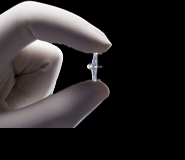
ENDOTINE TransBleph

The ENDOTINE TransBleph has brought about a change in how both surgeons and patients look at rejuvenation of the eyes. Now it is possible for you to offer your patients the benefits of a brow lift and blepharoplasty through a single upper lid bleph incision and under a local anaesthetic.

Surgeons have long faced the problem of patients who come to see them complaining of tired or old looking eyes and asking them to remove excess eyelid tissue thinking this will solve their problem. In actual fact, part of the problem with the patient's eyes is brow ptosis which will not be corrected by simply removing the excess lid tissue. Often the patient opts out of surgery when they learn they really need a brow lift or they decide to proceed with the blepharoplasty anyway. Both of these situations are bad news for you, the latter especially as the patient is rarely happy with the result and this can lead to negative word of mouth.

This is where the ENDOTINE TransBleph comes in. The ENDOTINE TransBleph allows you to offer your patients real rejuvenation of the eyes by combining the benefits of a brow lift and a blepharoplasty without the need for a GA or the extra incisions and downtime associated with a conventional brow lift and a fraction of the cost of a brow lift. Meaning you can provide your patients with the treatment they need with less downtime and minimal visible scarring at a price they can afford.

TransBlepharoplasty Brow Lift

A TransBleph brow lift can be performed in around 30 minutes by a surgeon experienced in the procedure. If you are new to the procedure, you should allow about 10-15 minutes per side over and above the time taken to perform your standard blepharoplasty.

The first step in performing the procedure is deciding which device to use. There are two sizes of ENDOTINE TransBleph; the 3.0 and 3.5. This number refers to the length of the tines in mm and as a general rule the 3.5 should be used. The 3.0 should be used for patients with very thin tissue where palpability may be an issue.

With the devices ready, you should make the lower limb of your upper bleph incision in the crease of the eyelid as you would for a standard upper blepharoplasty. dissect the lid in a sub orbicularis, pre septal plane to the orbital rim. Once you have reach the orbital rim, you should make an incision through the tissue and periosteum about 2mm above the rim.

Staying lateral to the supra-orbital nerve, dissect sub periosteally up to the hairline and across to the temporal crest. You may find it helps with elevating the brow tissue if you divide the conjoint fascia for about 2.5cm.

Once you have released the brow you will need to retract the tissue to reveal the bone. The next step is to drill a small hole in which the ENDOTINE TransBleph will be placed. This hole should be drilled with the supplied drill bit which is designed to provide the exact hole required. The drill hole should be positioned between the lateral limbus and the lateral canthus (depending on the look required) and should be at least 10mm above the orbital rim.

TransBleph with suturePrior to placing the device it is advisable to run a suture through the two holes in platform as shown in the image to the right. This suture is later passed through the periosteum and more superficial tissues to minimise tissue laxity and provided added holding strength.

The device is then placed by positioning the anchoring post over the hole and pressing down with firm pressure. You will feel the device click in place and sometimes you can hear a pop as it seats in the hole.To release the device from the insertion tool, simply twist the handle anti-clockwise and dispose of it.

You can now pass the needle through the a portion of the elevated periosteum and superficial tissues and lift the periosteum such that the incised edge is elevated and hooked over the tines of the TransBleph device. Once this is done, you can tie off the suture. This will firmly lock the periosteum onto the tines. You can then also press the tissue onto the tines to hold it all firmly in place.

At this point you can evaluate how much tissue should be removed from the eyelid, remove it and close using your usual technique.

No special dressings are required on the wound however it is advisable to use a pressure dressing across the brow for the first few days following the procedure. You should also advise your patient to try not to bend over and to sleep sitting up for a few days following the procedure.

TransBleph Procedure

Instrument Requirements

Performing a TransBleph brow lift does not require any special instrumentation over and above what you would normally have to hand. You will need a periosteal elevator, a retractor such as a Des-Mares and a drill. A manual drill is preferable as the drill hole being precise is critical to the success of the procedure however if a manual drill is not available, any drill with a jacobs chuck and on which the speed can be controlled will be fine.

The drill bit is included in the package with the implant and is sterile.

If you require any instrumentation, we have a wide range of high quality instruments at a very reasonable price. To find out more, just click on the instrumentation link below.

Ordering Codes

CFD-080-0177 ENDOTINE TransBleph 3.0
CFD-080-0167 ENDOTINE TransBleph 3.5
CFD-899-4000 Coapt Manual Surgical Drill


Home | Forehead | Midface | Ribbon | SurgiWire | EkkyLite LASH

NewGel+ | Cereform | Hydrelle | Instrumentation | Contact